Iridium (Ir): Key Metal for the Hydrogen Economy
What is iridium?
Iridium (chemical symbol: Ir, atomic number 77) is a silvery-white, extremely hard and dense transition metal from the platinum group. It was discovered in 1803 by the English chemist Smithson Tennant and named after the Greek goddess Iris — because of the colourful compounds it forms.
Iridium is the most corrosion-resistant of all known metals and one of the rarest elements in the Earth's crust. It occurs mainly as a byproduct of platinum and nickel mining and is used in high-performance applications due to its exceptional physical properties — from aerospace to hydrogen electrolysis.
Iridium is one of the rarest elements in the Earth's crust — up to 10 times scarcer than platinum and up to 40 times scarcer than gold. Recovered only as a by-product of platinum and nickel refining, just a few tonnes reach the market each year, making it one of the most exclusive precious metals in existence.
Physical properties of iridium
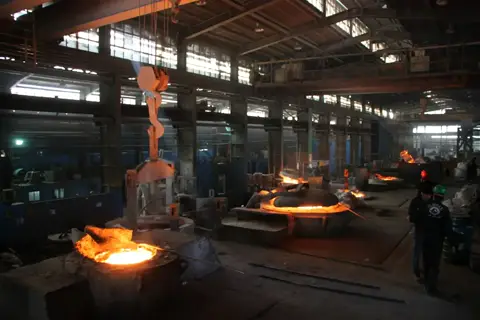
Iridium is characterised by a unique combination of physical properties that distinguishes it from all other metals. It is among the densest naturally occurring elements and possesses extraordinary hardness and corrosion resistance — even at extremely high temperatures.
These properties make iridium the preferred material for applications requiring durability and precision under extreme conditions — such as high-temperature contacts, laboratory equipment, and aerospace engineering.
| Property | Value |
|---|---|
| Atomic number | 77 |
| Atomic mass | 192.217 u |
| Density | 22.56 g/cm³ |
| Melting point | 2,446 °C |
| Boiling point | 4,428 °C |
| Crystal structure | face-centred cubic (fcc) |
| Mohs hardness | 6.5 |
| Corrosion resistance | highest of all known metals |
| Colour | silvery-white with slight yellowish tint |
Industrial applications of iridium
Although iridium is one of the rarest elements, it plays an indispensable role in numerous high-tech industries. Its unique combination of hardness, heat resistance, and chemical inertness makes it the material of choice for the most demanding applications.
Spark plugs and automotive: Iridium spark plugs are the gold standard in modern engines. The extremely fine iridium electrode enables a more precise spark, higher efficiency, and a lifespan of up to 100,000 km.
Hydrogen electrolysis: In PEM electrolysers (Proton Exchange Membrane), iridium serves as a catalyst for oxygen evolution. This technology is critical for the production of green hydrogen — a key element of the energy transition.
Aerospace: Iridium alloys are used in engine nozzles and high-temperature components where other materials would fail.
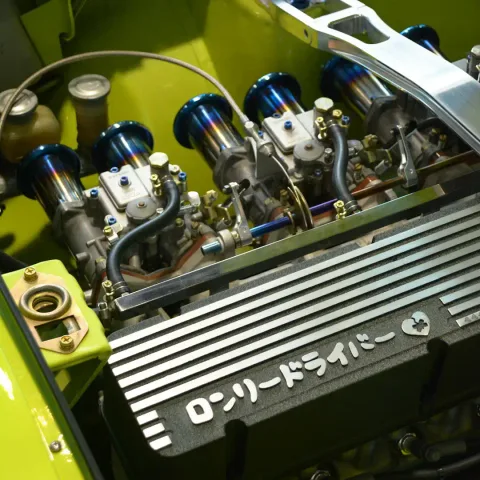
Spark plugs
Iridium electrodes for longer lifespan and higher efficiency in modern combustion engines.
Hydrogen electrolysis
Catalyst in PEM electrolysers for the production of green hydrogen.
Medical technology
Radioactive iridium-192 is used in brachytherapy for cancer treatment.
Aerospace
High-temperature-resistant alloys for engines and satellite components.
Rising demand for green hydrogen could multiply iridium consumption in the coming decades. With supply extremely limited, analysts see significant upside potential.
Iridium in the hydrogen economy
Iridium plays a key role in the production of green hydrogen. In PEM electrolysers (proton exchange membrane), iridium oxide serves as a catalyst on the anode side, where water is split into oxygen and hydrogen. No other material achieves the same combination of catalytic activity and long-term stability under the aggressive conditions of oxygen evolution.
The problem: global iridium production of around 7 tonnes per year is not sufficient at current loading rates to meet the projected expansion of electrolysis capacity. Germany's National Hydrogen Strategy envisions ten gigawatts of electrolysis capacity by 2030 — globally, only around five gigawatts currently exist. Each of these electrolysers requires iridium.
Research is therefore working on two fronts: first, on reducing iridium loading per electrolyser — researchers at Fraunhofer IAP developed catalysts in 2025 that achieve the same performance with one quarter of the previous iridium content [1]. Second, on single-atom catalysts, where iridium atoms are specifically distributed on carrier materials to further minimise precious metal usage [2].
Are there alternatives to iridium?
The most promising candidate is ruthenium — another platinum group metal that is roughly 7.5 times cheaper than iridium and has higher catalytic activity [3]. The problem: pure ruthenium dioxide dissolves after only a few hundred hours under the aggressive conditions of PEM electrolysis, while iridium remains stable for tens of thousands of hours. Recent breakthroughs show, however, that ruthenium can be significantly stabilised through doping with nickel, manganese, or tungsten — researchers at Rice University achieved over 1,000 hours of operation under practical conditions with a nickel-stabilised ruthenium catalyst for the first time [3]. Mixed catalysts of iridium and ruthenium are already commercially available and reduce iridium demand by up to 30% [4].
Completely iridium-free solutions based on transition metals such as manganese, cobalt, or iron currently exist only at laboratory scale — they dissolve too quickly in the acidic environment of PEM electrolysis [5]. In the short term, iridium will therefore remain indispensable. The question is not whether iridium will be replaced, but how much demand per electrolyser can be reduced — and whether this efficiency gain keeps pace with the planned expansion of electrolysis capacity.
For investors, this dynamic means: industrial demand for iridium is rising structurally — regardless of whether loading per electrolyser decreases, because the total number of installed electrolysers is set to grow massively. Iridium thus stands at the centre of a bottleneck that directly affects the energy transition.
[1] Fraunhofer IAP, "Iridium-reduced catalysts for cost-effective production of green hydrogen," January 2026. Project Power-to-MEDME-FuE (BMFTR-funded, Oct. 2023 – Dec. 2025). Available at: iap.fraunhofer.de
[2] Korea Institute of Science and Technology (KIST), single-atom iridium catalyst on nickel-manganese support. Reported in: ingenieur.de, "Ein Atom reicht: Iridium-Problem der Wasserstoff-Elektrolyse geknackt," February 2026.
[3] Z.-Y. Wu, F.-Y. Chen, B. Li et al., "Non-iridium-based electrocatalyst for durable acidic oxygen evolution reaction in proton exchange membrane water electrolysis." In: Nature Materials, 2022. DOI: 10.1038/s41563-022-01380-5
[4] Heraeus Precious Metals, iridium-ruthenium oxide catalysts for PEM electrolysis. Up to 50× higher mass activity than pure IrO₂, commercially available for over 10 years. Available at: heraeus-precious-metals.com
[5] Nankai University, review of manganese-doped catalysts for acidic water electrolysis. Reported in: highways.today, "Manganese Redefines the Economics of Acidic Water Electrolysis," February 2026.
Occurrence and mining of iridium
Iridium is one of the rarest elements in the Earth's crust with a concentration of only about 0.001 ppm (parts per million). By comparison: gold occurs at approximately 0.004 ppm, four times more frequently. Since sources vary with their numbers, iridium could even be up to 40 times scarcer than gold.
Global iridium production is only about 7 tonnes per year. The majority comes as a byproduct of platinum and nickel mining, mainly from South Africa (over 80% of world production), followed by Russia, Zimbabwe, and Canada.
Extraction is extremely labour-intensive: from one tonne of platinum ore, only about 3 grams of iridium are extracted. This complex refining process and the natural scarcity make iridium one of the most valuable metals in the world.

A note on data sources
Crustal abundance
Published estimates for iridium's abundance in the Earth's crust vary considerably between sources, because all platinum-group elements occur at parts-per-billion (ppb) levels where measurement is difficult and local concentrations can differ by orders of magnitude. Consensus geochemical figures place iridium at roughly 0.4 ppb by weight, with several peer-reviewed sources citing an average mass fraction of about 0.001 ppm (1 ppb). Against gold's commonly cited crustal abundance of ~1.5 ppb, this makes iridium roughly 2 to 4 times scarcer than gold by most estimates — though some mineralogical studies put gold at around 40 times more abundant, which would place iridium toward the upper bound of up to ~40× scarcer. We state this as a range rather than a single multiplier, because the figure genuinely depends on which dataset is used.
Annual production
Iridium is recovered almost entirely as a by-product of platinum and nickel refining, with global annual production on the order of only a few tonnes — a fraction of gold's ~3,000+ tonnes per year. This production gap is far larger than the geological scarcity ratio alone, because iridium has no primary ore of its own and supply is tied to other metals' mining output.
Why we hedge
Where you see "much rarer than gold" on this page, the claim is defensible by any measure — iridium is unambiguously rarer than gold in both crustal abundance and annual production. We deliberately avoid a single precise multiplier (e.g. "N× rarer") in customer-facing copy, since a well-informed reader can find a source giving a different number. The figures above are drawn from independent scientific and government sources, not from commercially interested industry bodies.
- WebElements — Iridium: geological information (crustal abundance ~0.4 ppb by weight). https://www.webelements.com/iridium/geology.html
- WebElements — Gold: geological information (crustal abundance ~1.5 ppb by weight). https://www.webelements.com/gold/geology.html
- Chemical Geology (1984), "Abundance and distribution of palladium, platinum, iridium and gold in some oxide minerals" — iridium ~0.001 ppm; gold ~40× and platinum ~10× more abundant. https://www.sciencedirect.com/science/article/abs/pii/0009254184901426
- Journal of Radioanalytical and Nuclear Chemistry (2011), s10967-011-1332-3 — iridium average mass fraction 0.001 ppm in crustal rock. https://link.springer.com/article/10.1007/s10967-011-1332-3
- U.S. Geological Survey — Mineral Commodity Summaries: Platinum-Group Metals (annual production figures). https://www.usgs.gov/
Iridium vs. platinum: precious metals comparison
Although both belong to the platinum group, iridium and platinum differ significantly in their properties, availability, and areas of application. This comparison is particularly insightful for investors and collectors.
| Property | Iridium | Platinum |
|---|---|---|
| Density | 22.56 g/cm³ | 21.45 g/cm³ |
| Melting point | 2,446 °C | 1,768 °C |
| Annual production | ~7 tonnes | ~190 tonnes |
| Corrosion resistance | Highest of all metals | Very high |
| Main application | Catalysis, spark plugs | Catalysts, jewellery |
| Exchange trading | Not exchange-traded | NYMEX, LBMA |
| Availability | Extremely limited | Limited |
Since iridium is not traded on a commodity exchange, its price is less susceptible to speculative fluctuations. Price formation is based on real industrial supply and demand dynamics.
For a detailed comparison of all precious metals — including osmium and rhodium — see our precious metals comparison.
Iridium as investment: opportunities and characteristics
Iridium has attracted increasing investor interest in recent years. The price rose from below $500 per ounce in 2018 to over $6,000 in 2021 — an increase that reflects the fundamental scarcity of the metal.
As a physical investment, iridium offers several unique advantages: it is chemically nearly indestructible, extremely compact (highest density of all platinum group metals), and benefits from growing demand from the hydrogen economy.
MetaMetals offers certified iridium bars as 1 oz (31.1 g) bars — sintered in Austria, with a digitally signed PDF certificate of authenticity and serial number.
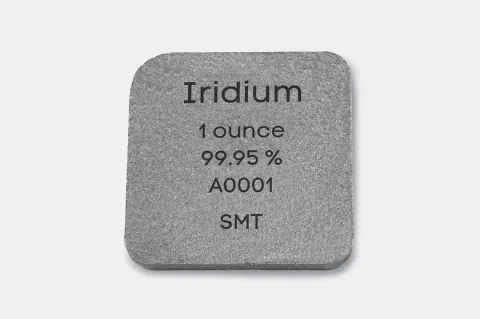
Interested in investing? Find current iridium prices and information on buying iridium bars.
Certification and safety at MetaMetals
Every iridium bar purchased from MetaMetals comes with a digitally signed PDF certificate of authenticity confirming the purity (minimum 99.95%), a minimum weight, and serial number. The certificate is issued by MetaMetals and can be independently verified.
All orders are shipped fully insured from Austria. Valuables are sent via insured tracked shipping to ensure maximum security. Packaging is discreet — with no indication of contents.
PDF certificate of authenticity
Digitally signed certificate confirms purity, weight, serial number, and origin for every bar.
Serial numbers
Each bar is individually numbered and traceable from production to customer.
Insured shipping
Full insurance from our vault to your door with tracking for every order.
EU consumer protection
As an Austrian company, we are subject to strict EU consumer protection laws.
Find answers to the most frequent questions here.
Why buy iridium from MetaMetals?
- Certified iridium bars (1 oz)
- Digitally signed PDF certificate of authenticity
- Secure payment: card, PayPal, bank transfer & more
- Insured shipping from Austria
- Purity minimum 99.95%
- Austrian precious metals dealer
- EU consumer protection laws apply
- Personal support via email, phone & chat